
mail
kjamrvpsv@gmail.com
whatsapp
+919447535633
e-ISSN: 3107-4057
logo

Kottakkal Journal of Ayurvedic Medicine And Research

Kottakkal Journal of Ayurvedic Medicine And Research

Advancing knowledge through rigorous peer-reviewed research across multiple disciplines. Join the global community of scholars shaping the future of academic discovery.

📢 Latest Update: New special issue call for papers on "Emerging Technologies in Research" - Submit by March 31, 2025

📢 Latest Update: New special issue call for papers on "Emerging Technologies in Research" - Submit by March 31, 2025

Important Journal Details

Title:
Kottakkal Journal of Ayurvedic Medicine And Research
Journal Short Name:
KJAMR
e-ISSN (Online):
3107-4057
Year of Establishment:
2025
Frequency of the Publication:
Quarterly
Publication Format:
Online
Related Subject:
Ayurvedic MedicineResearch
Language:
English
Editor-in-Chief:
Dr. Bindu KK
Editorial Board:
Click Here →
Journal's Email ID:
kjamrvpsv@gmail.com

Download Forms & Formats

Download Hub

Publisher Details

Responsible Person Name:
Sri. Neelakandan A. N.
Name of Publishing body:
Bhishak Publication Division, Kerala Ayurvedic Studies and Research Society
Publisher Website Url:
https://kjamr.scholarjms.com
Address:
Chief Executive Officer, Kerala Ayurvedic Studies and Research Society, Kottakkal, Kerala, 676501

Journal Features

Rigorous Peer Review

All submissions undergo thorough evaluation by experts in the field to ensure quality and validity.

Global Reach

Published papers reach an international audience of researchers, academics, and industry professionals.

Rapid Publication

Efficient review process ensures timely publication of accepted papers without compromising quality.

Open Access

All published papers are freely accessible online, maximizing visibility and impact of your research.

Publication Process

1

Prepare Manuscript

Format your paper according to our guidelines

View Guidelines
style="fill: var(--journal-600);"
2

Submit Paper

Upload your manuscript through our system

Submit Now
3

Peer Review

Your paper undergoes expert evaluation

Learn More
4

Publication

Accepted papers are published worldwide

View Publications
View All Issues
Cover image for A UNIDIMENSIONAL APPRAISAL OF THE PRAGMATIC APPLICATION OF JALAPRATARAṆA AS A HETU-VYADHI VIPAREETARTHAKARI VIHARA UPASHAYA IN URUSTHAMBHA W.S.R. TO THERAPEUTIC IMPACT OF SWIMMING IN THE MANAGEMENT OF LIPID MYOPATHIES

A UNIDIMENSIONAL APPRAISAL OF THE PRAGMATIC APPLICATION OF JALAPRATARAṆA AS A HETU-VYADHI VIPAREETARTHAKARI VIHARA UPASHAYA IN URUSTHAMBHA W.S.R. TO THERAPEUTIC IMPACT OF SWIMMING IN THE MANAGEMENT OF LIPID MYOPATHIES

Dr Anand S

Roga pareeksha and Rogi pareeksha constitute the two primary diagnostic components of Ayurveda. Nidana panchaka—comprising Hetu, Purvaroopa, Roopa, Upashaya-Anupashaya & Samprapti - serves as a comprehensive diagnostic framework for understanding the modalities of roga pareeksha. Among these, Upashaya and Anupashaya exemplify a trial-and-error approach applied prior to definitive diagnosis and treatment selection. The Upashaya method is particularly valuable when clinical symptoms overlap, aiding in differential diagnosis through therapeutic testing. Administration of Ahara, Vihara, or Aushadha that acts contrary to the Hetu, Vyadhi, or Hetu-Vyadhi is termed Vipareeta upashaya, whereas the approach that aligns with them is known as Vipareetartakari upashaya. Though the concept of vipareetarthakari upashaya appears complex, our Acharyas have provided clear rationales to justify its therapeutic relevance. A classical example is the advocacy of jalapratarana in urusthambha, an application of hetu-vyadhi vipareetarthakari vihara upashaya. Urusthambha is a disorder best managed through Ayurvedic shamana aushadhis. However, jalachankramana chikitsa as described by Acharya Charaka proves particularly effective by facilitating the vilayana of accumulated meda dhatu in the uru pradesha, thereby restoring the normal function of avruta vata. Pathologically, Urusthambha can be correlated with lipid myopathies, wherein adiponectin and endothelin-1 play crucial roles. Adiponectin exerts a protective effect by promoting fatty acid oxidation and reducing lipid accumulation in muscle cells, suggesting its potential as a novel therapeutic target for myopathies. Interestingly, studies indicate that cold-water swimming elevates adiponectin levels, thereby imparting beneficial effects on the musculoskeletal system. Moreover, combined interventions such as whole-body cryotherapy and cold-water swimming are known to elevate HDL levels while reducing LDL and total cholesterol. Experimental studies on animal models further support the beneficial effects of swimming exercise in mitigating myopathies via reducing ET-1, enhancing vascular function and decreasing ET-1 mediated vasoconstrictor tone.
Cover image for THE TRUE IDENTITY OF AMṚTOTTARAM KAṢĀYAM: EARLY MANUSCRIPT EVIDENCE ON THE RATIO OF INGREDIENTS

THE TRUE IDENTITY OF AMṚTOTTARAM KAṢĀYAM: EARLY MANUSCRIPT EVIDENCE ON THE RATIO OF INGREDIENTS

Madhu Koythodi Parameswaran, Sandrima Priya Sanjeevan

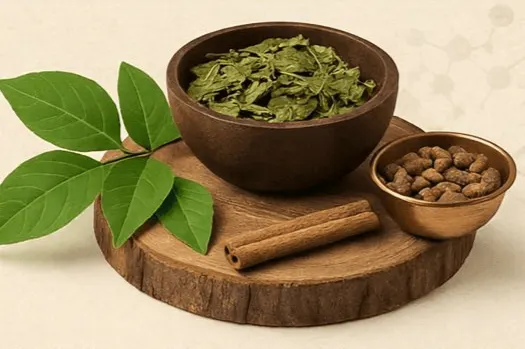
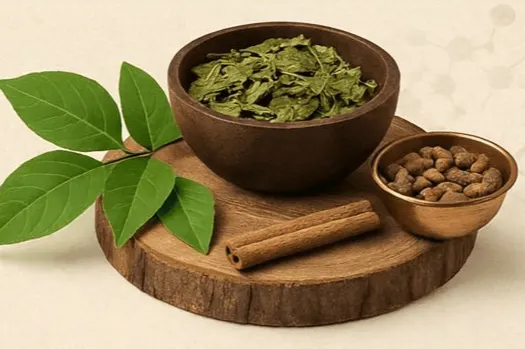
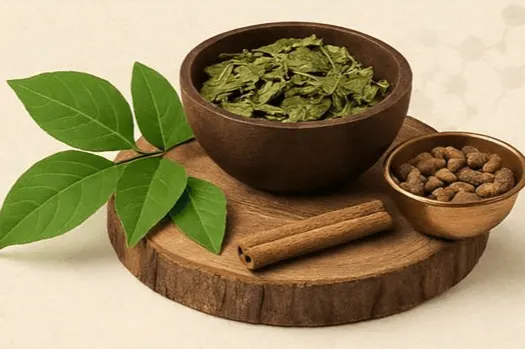
Introduction: Amṛtottaraṃ kaṣāyam is a widely prescribed polyherbal Ayurvedic recipe with Nāgara (Zingiber officinale), Amṛtā (Tinospora cordifolia), and Harītakī (Terminalia chebula) in the ratio if 2:6:4 or 1:3:2, thus satisfying the meaning of its name as the ‘one with a predominance [in quantity] for Amṛtā’. The widely cited reference for this recipe is the Sahasrayoga, where most editions describe the recipe titled Nāgarādi kaṣāyam as having the specific ratio widely accepted as that of the Amṛtottaraṃ kaṣāyam. The possibility of varied interpretations of the phrase ‘Nāgahastanayanāṅghribhāgaśaḥ’ has led to controversy over whether the Nāgarādi kaṣāyam cited in the Sahasrayogamcould indeed be considered the Amṛtottaraṃ kaṣāyam. This article uses a critical edition of the verse and a commentary seen in some manuscripts of the Sahasrayogam to elicit an alternate method of interpreting the above said phrase to deduce the ratio of ingredients. Materials and Methods: Four manuscripts (with sigla O, C1, C2, and C3) from two collections of manuscripts (Oḷaśśa family and Calicut University), along with the vulgate print edition of A S Gopala Pillai (S), were used to prepare the critical edition. Discussion and Conclusion: The commentary contained in the manuscripts of Sahasrayogam uses three different meanings of the word ‘Nāga’ (Nara, Triphaṇisarpa and Gaja) to qualify Hasta, Nayana and Aṅghri. Thus, the number of Narahasta (hands of a man) indicates the ratio of Nāgara (2), the number of Triphaṇisarpanayana (eyes of a three-hooded serpent) indicates the ratio of Amṛtā (2x3=6) and the number of Gajāṅghri (legs of an elephant) indicates the ratio of Harītakī (4). This commentary offers a simple and less convoluted interpretation of the meaning of the word ‘Nāgahastanayanāṅghribhāgaśaḥ’ to reach the widely accepted ratio of ingredients of the Amṛtottaraṃ kaṣāyam.

Cover image for AYURVEDA AND NEW BIOLOGY: INTEGRATING ANCIENT WISDOM AND MODERN SCIENCE

AYURVEDA AND NEW BIOLOGY: INTEGRATING ANCIENT WISDOM AND MODERN SCIENCE

Sudhakaran P R, Divya M V, Rajmohan V

Ayurveda, with its emphasis on Prakriti (individual constitution), Tridosha (functional principles), Rasayana (rejuvenation), and lifestyle-based prevention, provides a time-tested framework for personalised and preventive healthcare. In parallel, New Biology, empowered by high-throughput omics technologies, epigenetics, systems biology and network pharmacology offer novel tools to decode biological complexity at multiple scales. This article examines how emerging research in new biology and Ayurveda, is integrating empirical traditions with molecular science by translating traditional views into quantifiable biological correlates. The promise of network pharmacology to reveal the synergistic mechanisms of polyherbal formulations, multi-omics techniques to examine Prakriti and systems modelling to predict health and disease dynamics are discussed. Together, Ayurveda and New Biology form the basis for predictive, preventive and personalised medicine. This approach suggests a scientifically coherent and sustainable model that advances Ayurveda into a data-driven, evidence-based discipline, bridging traditional principles with precision medicine.

Publication Process

Learn about our 4-step publication process

Submission Guidelines

Review requirements before submitting

Submit Article

Ready to submit your research?

30
Published Articles
1,523
Active Researchers
45
Countries
4.2
Impact Factor