
mail
kjamrvpsv@gmail.com
whatsapp
+919447535633
e-ISSN: 3107-4057

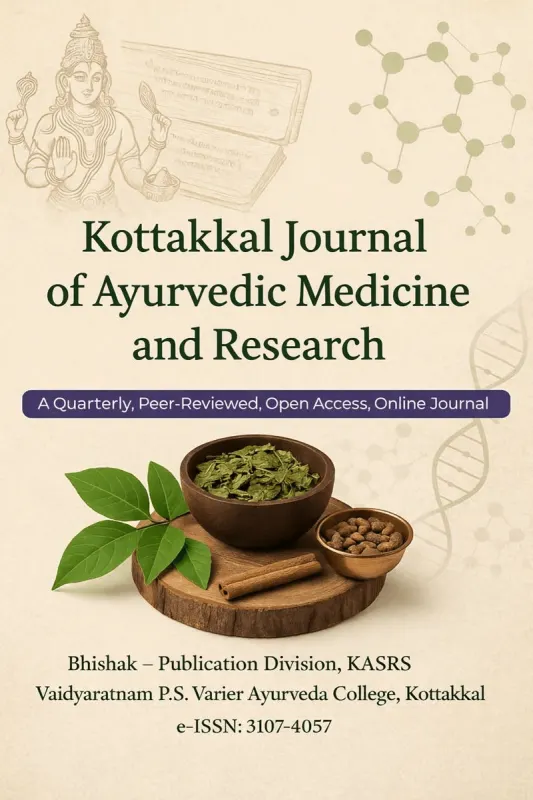
Kottakkal Journal of Ayurvedic Medicine And Research

📢 Latest Update: New special issue call for papers on "Emerging Technologies in Research" - Submit by March 31, 2025

📢 Latest Update: New special issue call for papers on "Emerging Technologies in Research" - Submit by March 31, 2025

April-June 2025

Volume 1, Issue 2 - undefined null

Volume 1 Issue 2 Cover

Issue Details:

Volume 1 Issue 2
Published:Invalid Date

Editorial: April-June 2025

Welcome to the issue of Kottakkal Journal of Ayurvedic Medicine And Research. This issue showcases the remarkable breadth and depth of contemporary research across multiple disciplines. From cutting-edge applications of machine learning in climate science to the revolutionary potential of quantum computing in drug discovery, our featured articles demonstrate the power of interdisciplinary collaboration in addressing global challenges.

We are particularly excited to present research that bridges traditional academic boundaries, reflecting our journal's commitment to fostering innovation through cross-disciplinary dialogue. The integration of artificial intelligence with environmental science, the application of blockchain technology to supply chain management, and the convergence of urban planning with smart city technologies exemplify the transformative potential of collaborative research.

As we continue to navigate an era of rapid technological advancement and global challenges, the research presented in this issue offers both insights and solutions that will shape our future. We thank our authors, reviewers, and editorial board members for their continued dedication to advancing knowledge and promoting scientific excellence.

Dr. Margaret Thompson
Editor-in-Chief
Kottakkal Journal of Ayurvedic Medicine And Research

Articles in This Issue

Showing 6 of 6 articles
Research PaperID: KJAMR-00000022

AN OBSERVATIONAL STUDY TO ASSESS THE CHANGES IN OJAS AND DHATU SAARATA AMONG INDIVIDUALS ON LOW CARBOHYDRATE DIET

Dr.Sahad T, Dr.Anjali Sivaram

Introduction: A restricted diet is more often pursued by those wanting to lose weight. Nowadays, the number of people following diet plans have increased and many of them choose low carbohydrate diet for the purpose of their diet plan. A low carbohydrate diet limits intake of carbohydrates and emphasizes on food high in protein and fat. Among different fundamental concepts of Ayurveda, ojas is a unique concept that explains about the basic status of physical and mental health in an individual. Saara is the purest form of a dhatu and ojas is its vital part. It is responsible for health, immunity, consciousness, longevity and memory. So, a reflection of the health status of an individual can be made by assessing the status of ojas. Dhatu saarata means the excellence of each dhatu and saara pareeksha can determine the qualitative excellence of each dhatu. Since ojas and dhatu saarata can reflect the strength or health of an individual, assessing them on individuals taking low carbohydrate diet can give an idea about their health status. Materials & methods: The present study was an observational study. Individuals taking low carbohydrate diet were selected for the study in a consecutive fashion from the Nutrition Centre, Naripparambu, Tirur, Kerala as per the inclusion criteria. After obtaining written informed consent, Ojas was assessed using the validated tool for the assessment of status of ojas, which was developed in the department of Kriyasareera, Government Ayurveda College, Kannur, Kerala by Dr Amrutha Elamon. Dhatu saarata was assessed using the validated computer assisted questionnaire software, Ayusoft developed by C–DAC Pune. The participants were observed for a period of one month. To examine the changes, the assessments were repeated after one month. Result and discussion: It was observed that, a significant increase in ojas was observed. Change in dhatu saarata could be observed except in majja saarata. Rasa, asthi, shukra satva and sarva saarata showed increase while decrease was noticed in rakta, mamsa and medo saarata the reduction in weight might be the reason for the changes in saarata as well as ojas as it reduces medo dhatu and avarana if any, leading to the improvement in overall health. Conclusion: Taking low carbohydrate diet for a period of one month can improve the ojas and dhatu saarata significantly. But the results cannot be extrapolated into a general postulate, as the findings can vary for a different time period of diet intake.

Low carbohydrate dietDhatu saarataOjas
1,886 views
684 downloads

Contributors:

 Dr.Sahad T
,
 Dr.Anjali Sivaram
Research PaperID: KJAMR-00000027

CLINICAL ORTHOPEDICS IN AYURVEDA - EVOLVED CASES AND INSIGHTS

Dr.K.Devikrishnan

CLINICAL ORTHOPEDICS IN AYRVEDA – EVOLVED CASES AND INSIGHTS documented by Dr. Gikku Alias Benny has become now recognizable to young doctors. This title explains the practical aspects of bone fractures and their treatment processes. The author consistently focuses on the basic ayurvedic orthopedics described in Sushrutasamhita. It has included the application of modern investigatory techniques like computerized tomography (CT) radiographic scanning and magnetic resonance imaging (MRI) and is an important document in the direction of evidence based medicine. The book which is into its second edition is a much needed handbook for practitioners. Physicians practicing evidence-based medicine must acquire new competencies, such as effective literature searches and the use of explicit principles of evidence when assessing clinical literature.

Clinical orthopedicsEvidence-based medicineFracture
2,568 views
776 downloads

Contributors:

 Dr.K.Devikrishnan
Research PaperID: KJAMR-00000025

HEALING BEYOND BORDERS: THE ROLE OF AYURVEDA IN MEDICAL TOURISM

Dr Kartik Sharma, Dr Vishal Chaudhary

Introduction: Ayurveda, a centuries-old system of medicine, offers a holistic approach to addressing modern health challenges such as chronic diseases, stress, and lifestyle disorders. With the rising global demand for integrative medicine, India's rich Ayurvedic heritage provides unique opportunities for sustainable medical tourism and global healthcare innovation. Methods: This paper employs a multidisciplinary approach, analyzing the principles of Ayurveda and their applicability to contemporary health issues. Data from studies on the efficacy of Ayurvedic treatments, economic reports on medical tourism, and global health trends were reviewed. Strategies for scaling Ayurvedic healthcare globally were assessed while emphasizing authenticity and ethical practices. Results: The analysis indicates that Ayurveda can complement allopathic medicine through personalized treatments, preventive care, and stress management techniques. Ayurvedic therapies, such as Panchakarma, have shown efficacy in managing lifestyle-related disorders. Additionally, Ayurveda-focused medical tourism has significantly contributed to India's economy, attracting global tourists seeking wellness and integrative treatments. Discussion: Ayurveda’s principles align with modern healthcare needs, promoting sustainable practices and addressing the rising prevalence of non-communicable diseases. Integrating Ayurvedic care with allopathic approaches can enhance patient outcomes. However, scaling Ayurvedic healthcare requires addressing challenges such as standardization, global regulatory approvals, and maintaining authenticity in international markets. Conclusion: Ayurveda holds immense potential to address global health challenges while fostering sustainable medical tourism. By leveraging its holistic principles and complementary approaches to modern medicine, Ayurveda can contribute to global healthcare solutions. Strategic efforts to scale Ayurvedic practices internationally must prioritize quality, ethical practices, and cultural integrity.

AyurvedaMedical Tourism
2,132 views
808 downloads

Contributors:

 Dr Kartik Sharma
,
 Dr Vishal Chaudhary
Research PaperID: KJAMR-00000023

INTEGRATING AYURVEDIC PRINCIPLES INSPORTS MEDICINE: A HOLISTIC APPROACH TO ATHLETIC PERFORMANCE AND INJURY PREVENTION

Amrutha K, Sunitha P V

Ayurveda, the ancient Indian system of medicine, is one of the oldest medical traditions in the world, offering holistic approaches to health and wellness. Sports medicine is a specialized field that focuses on physical fitness, injury prevention and the management of sports-related conditions. While Ayurveda does not explicitly mention sports medicine as a distinct discipline, its principles can be effectively applied to enhance athletic performance and prevent injuries. By carefully analyzing Ayurvedic texts, we can derive valuable insights into the management of sports-related issues through concepts such as Dinacharya (daily regimen), Ritucharya (seasonal regimen), Ahara-Vihara (diet and lifestyle) and Oushadha (herbal formulations). Additionally, through Dasavidha Pareeksha, particularly Prakriti Pareeksha, Ayurveda can help in selecting suitable sports activities based on an individual's constitution, thereby optimizing performance and reducing the risk of injuries. This review aims to explore hidden references within Ayurveda that contribute to the field of sports medicine and highlight its potential in promoting overall physical and mental well-being in athletes.

AyurvedaSports MedicinePrakritiInjury PreventionPerformance Enhancement
2,182 views
590 downloads

Contributors:

 Amrutha K
,
 Sunitha P V
Research PaperID: KJAMR-00000024

SCOPE OF INTEGRATED MANAGEMENT OF BEHAVIORAL DISORDERS IN CHILDREN - A CASE BASED ANALYSIS

Asha V, Alma P Wilson, Vinod R, Aparna P M

Background: Behavioral disorders in children significantly impact their cognitive, emotional, and social development. Conditions like Attention Deficit Hyperactivity Disorder (ADHD), conduct disorders, and emotional disturbances require a multidisciplinary approach for effective management. While conventional treatments focus on medications and behavioral therapy, Ayurveda offers a holistic approach, addressing underlying imbalances through Panchakarma, Medhya Rasayana, and Satvavajaya Chikitsa. Objective: The article explores the scope of an integrated management approach for behavioral disorders in children, combining Ayurvedic interventions, psychological therapy, parental education and special education. A case-based analysis highlights the effectiveness of this approach in improving behavioral and cognitive outcomes. Methodology: A comprehensive literature review was conducted, along with a clinical case study of a 12- year-old girl with hyperactivity and aggressive behavior. The patient underwent an inpatient integrated treatment approach, including Ayurvedic therapies (Panchakarma, Medhya Rasayana), behavioral therapy, parental education, and yoga. The outcome was assessed using Conner’s Parent Rating Scale for ADHD before and after treatment. Results: Post-treatment, the patient demonstrated a significant reduction in aggressive behaviors, anger outbursts, and sleep disturbances. The Conner’s parent rating scale score improved from 51 to 30, reflecting better emotional regulation and cognitive function. Panchakarma therapies such as Virechana, Snehapana, and Nasya etc combined with behavioral therapy and yoga, contributed to sustained improvement. Conclusion: An integrated approach involving Ayurveda, psychological therapy and parental education provides a sustainable solution for managing childhood behavioral disorders.

ADHDAyurvedaMindYogaMedhya RasayanaGood parenting+2 more
2,116 views
746 downloads

Contributors:

 Asha V
,
 Alma P Wilson
,
 Vinod R
,
 Aparna P M
Research PaperID: KJAMR-00000026

SPORTS INJURIES : TREATMENT PROTOCOL AND COMMON CLINICAL PRACTICES

Jisna. V, Fahma Jebin KVM, Rejani Haridas, Sunitha P V

Athletic performance is closely linked to physical health, endurance and injury prevention. Conventional sports medicine primarily focuses on physiotherapy, orthopedic interventions and rehabilitation. However, an integrated, holistic approach is required to optimize recovery and long-term well-being which forms the basis for Sports Ayurveda. Ayurveda offers personalized injury management for both acute and chronic sports injuries by following basic Ayurvedic treatment principles and also uses valuable insights by eminent physicians. This could be in the form of internal medication, various kriyakrama and dietary advices to aid in musculoskeletal healing. Ayurvedic rehabilitation strategies combined with modern techniques enhance recovery and promote overall well-being.

Sports injuriesTreatment protocol – Phase wiseCommon clinical practicesSports Ayurveda
2,642 views
695 downloads

Contributors:

 Jisna. V
,
 Fahma Jebin KVM
,
 Rejani Haridas
,
 Sunitha P V
Whatsapp