
mail
kjamrvpsv@gmail.com
whatsapp
+919447535633
e-ISSN: 3107-4057

Kottakkal Journal of Ayurvedic Medicine And Research

📢 Latest Update: New special issue call for papers on "Emerging Technologies in Research" - Submit by March 31, 2025

📢 Latest Update: New special issue call for papers on "Emerging Technologies in Research" - Submit by March 31, 2025

January-March 2025

Volume 1, Issue 1 - undefined null

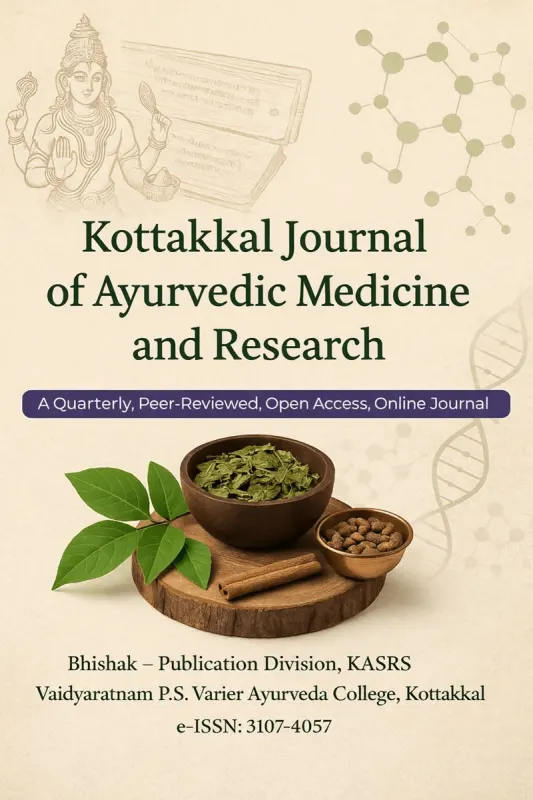
Volume 1 Issue 1 Cover

Issue Details:

Volume 1 Issue 1
Published:Invalid Date

Editorial: January-March 2025

Welcome to the issue of Kottakkal Journal of Ayurvedic Medicine And Research. This issue showcases the remarkable breadth and depth of contemporary research across multiple disciplines. From cutting-edge applications of machine learning in climate science to the revolutionary potential of quantum computing in drug discovery, our featured articles demonstrate the power of interdisciplinary collaboration in addressing global challenges.

We are particularly excited to present research that bridges traditional academic boundaries, reflecting our journal's commitment to fostering innovation through cross-disciplinary dialogue. The integration of artificial intelligence with environmental science, the application of blockchain technology to supply chain management, and the convergence of urban planning with smart city technologies exemplify the transformative potential of collaborative research.

As we continue to navigate an era of rapid technological advancement and global challenges, the research presented in this issue offers both insights and solutions that will shape our future. We thank our authors, reviewers, and editorial board members for their continued dedication to advancing knowledge and promoting scientific excellence.

Dr. Margaret Thompson
Editor-in-Chief
Kottakkal Journal of Ayurvedic Medicine And Research

Articles in This Issue

Showing 6 of 6 articles
Research PaperID: KJAMR-00000007

AN EXPLORATORY STUDY ON MANUSCRIPT TITLED “DĒHATTILĒ MAṚMA VIPARAṂ

Neenu Jessy Sabu, Kirathamoorthy P P, Bindu K K

Manuscripts are the handwritten documents which are available all over the world in different scripts and materials. Still many unpublished Ayurvedic manuscripts are available throughout India. Manuscripts are valuable treasures of knowledge which should be explored. Apart from the great tradition (Classical tradition) of Ayurveda, local or regional traditions developed substantially in different fields of Āyurveda among which Maṛma was an important one. The manuscript titled Dēhattilē Maṛma Viparaṃ is obtained from Samhita, Sanskṛt and Siddhanta department of Vaidyaratnam P.S. Varier Ayurveda College, Kottakkal. The study was done to make the knowledge contained in the unpublished manuscript available to the public and will become a new horizon of treatment and further research. The aim of the study was to enrich Āyurvedic knowledge base with special reference to Maṛma tradition through exploring the manuscripts. The objectives of the study were to make lower criticism on manuscript titled “Dēhattilē Maṛma Viparaṃ”. Many drugs mentioned in the manuscript were identified with the help of drug experts. Details regarding the manuscript was identified by discussion with manuscript experts and maṛma experts. Period of the manuscript and factors related to origin were identified from literary evidences in the manuscripts. Exploration of the manuscript identified maṛma different from that of classical books. It also revealed treatment for injury of maṛma with use of drugs. New formulations were also explored in the manuscript.

ManuscriptMaṛmaDēhattilē Maṛma Viparaṃ
1,123 views
477 downloads

Contributors:

 Neenu Jessy Sabu
,
 Kirathamoorthy P P
,
 Bindu K K
Research PaperID: KJAMR-00000008

CONCEPT OF KSHEERA AND GHRITA AS NITHYA RASAYANA

Amrutha C, M C Shobhana

Nutrition is a cornerstone of the Indian healing system of Ayurveda. It emphasizes the relationship between food, health and well-being. Rasayana is a vital component of Ayurveda that results in rejuvenation and preventive health care. Its holistic approach not only seeks to enhance physical well-being but also addresses mental and spiritual health, reflecting Ayurveda's comprehensive understanding of human health. Nithyam Ksheera Ghritabhyasa is a foundational Ayurvedic practice that promotes the daily consumption of milk and ghee, which are considered as sattvic foods. It promotes purity, strength, mental clarity and rejuvenate the body. Milk, which is rich in nutrients like protein and calcium supports bone health, enhances digestion and boosts immunity. Ghee, known for its nourishing properties, aids in detoxification and promotes mental clarity. Together, these foods helps to improve overall vitality and support the body’s natural rhythm. Incorporating ksheera and ghrita into daily diets through palatable preparations is vital for achieving the benefits of Nithya Rasayana. By utilizing various preparations mentioned in classics individuals can enjoy these nutritious substances regularly, thereby supporting their overall health and well-being. This review aims to gather scientific evidence supporting the Ayurvedic principle of Ksheeraghritaabhyaso Rasayananam, which emphasizes the regular intake of ghee (Ghrita) and milk (Ksheera) for rejuvenation and longevity.

Ksheeram GhritamNithyarasayanamPalatability
1,449 views
436 downloads

Contributors:

 Amrutha C
,
 M C Shobhana
Research PaperID: KJAMR-00000011

PADMABHUSHAN DR.P.K.WARRIER - THE CENTENARIAN BHISHAK WHO TOOK AYURVEDA TO THE WORLD

Dr. Bindu K K, Dr Uma Karthik

Padmabhushan Dr P.K. Warrier was an illustrious Ayurvedic physician who served as the managing trustee of Arya Vaidya Sala, Kottakkal for a period of 68 years. His approach to diagnosis and treatment of diseases was based on sound principles of diet and regimen. He was a person who fostered research in educational, clinical and pharmaceutical sectors through collaborations with reputed organisations. He played a key role in the dissemination of knowledge through Ayurveda Seminars and publication of articles for the scientific community as well as informative pieces for the common man. The Padma awardee breathed his last on July 10, 2021 leaving a huge void in the field of Ayurveda medicine.

1,800 views
467 downloads

Contributors:

 Dr. Bindu K K
,
 Dr Uma Karthik
Research PaperID: KJAMR-00000010

PROPHYLACTIC MANAGEMENT OF EXCESSIVE UTERINE BLEEDING WITH GUDUCHI RASAYANA

Anitha K Viswambharan

Excessive uterine bleeding or Asrigdara is either cyclical or non-cyclical. The condition is seen in all reproductive ages, but more common in pre menopause due to anovulatory cycles with or without endometrial hyperplasia .In active reproductive age groups, uterine lesions like fibroids , adenomyosis and D.U.B are the common causes of excessive uterine bleeding. The modern management of excessive uterine bleeding is with non steroidal anti inflammatory drugs, sex steroids, intrauterine devices and surgery. In almost all cases of Asrigdara, Ayurveda offers symptomatic cure giving due consideration to dosha predominance, prophylactic management to prevent excess bleeding and treatment for various lesions responsible for the symptom. Rasayana has an important role in Streeroga chikitsa. The most commonly used Rasayana medicines in Streeroga are Lasuna, Krishna Tila ,Bhallataka, Shatavari ,Satapushpa and Guduchi. This case report is on the prophylactic management of profuse and prolonged menstrual bleeding with the administration of Guduchi swarasa. Since the drug administration was done for 15 days preceding to her menstrual cycle, this was considered as a prophylactic management. After the therapy with Guduchi swarasa the subsequent menstrual bleeding of the subject had shown marked reduction in quantity and duration.

AsrigdaraGuduchi RasayanaProphylaxis
1,689 views
456 downloads

Contributors:

 Anitha K Viswambharan
Research PaperID: KJAMR-00000028

SAINDHAVA IN KSHEERAVASTHI

Fathima Moidoo, Fazeela C H

Vasthi is said to be a preventive, promotive and curative therapeutic intervention and is considered as ardhachikitsa among all therapies by different acharyas. Ksheera vasthi is a mrudu niruha vasthi. Functionally it acts as a dosha shamana and brimhana vasthi. It is mainly indicated in asthi pradoshaja and majjavaha sroto vikaras and when there is involvement of pitta and rakta. There is reference of ksheera being used as kashaya dravya and also as avapa dravya in vasthi kalpa and it is these formulations that are considered as ksheera vasthi. This observational study analyzed data from 40 participants who underwent Ksheeravasthi at VPSV Ayurveda College Hospital, Kottakkal, between January 1, 2025 and February 15, 2025. Notably, some participants received Saindhava (rock salt) as an ingredient while others did not. This variability prompted an investigation into the rationale behind the inclusion or exclusion of Saindhava in Ksheeravasthi preparations. Our findings will shed light on the theoretical and practical implications of using Saindhava in Ksheeravasthi, contributing to the optimization of this Ayurvedic treatment.

VasthiKsheeravasthiSaindhava
2,774 views
929 downloads

Contributors:

 Fathima Moidoo
,
 Fazeela C H
Research PaperID: KJAMR-00000013

VASTI SAMEEKSHA

Dr Binitha A, Dr Manojkumar A K, Dr Jigeesh P P, Riddhi Bharat Lunavat, Aswathy V J, Priya N K, Sanalkumar M P, Sinjith K P

The Department of Panchakarma at VPSV Ayurveda College, Kottakkal, conducted "Vasti Sameeksha," a comprehensive two-day workshop on December 7-8, 2024, focusing on the advanced Ayurvedic practice of Niruha. This workshop brought together 73 participants, including postgraduate scholars and faculty from leading Kerala Ayurveda colleges, to deepen the understanding and update practices of Niruha through classical and contemporary perspectives. The workshop was structured around 106 pre-collected questions on various aspects of Niruha such as indications, dosage, and procedures, which were extensively discussed to reconcile traditional texts with modern application needs. Moderated by experts Dr. Kirathamoorthy P.P. and Dr. G. Vinodkumar, the sessions facilitated a collaborative forum for standardizing operational procedures and exploring innovative formulations, notably the integration of Saindhava in Ksheera Vasti. The discussions also highlighted the challenges in clinical assessments and post-procedural care, stressing the need for ongoing research and adaptation of practices. This collaborative effort marked a significant step in standardizing Niruha treatments and documented the refined understandings for future educational and clinical use.

1,977 views
533 downloads

Contributors:

 Dr Binitha A
,
 Dr Manojkumar A K
,
 Dr Jigeesh P P
,
 Riddhi Bharat Lunavat
,
 Aswathy V J
,
 Priya N K
,
 Sanalkumar M P
,
 Sinjith K P
Whatsapp